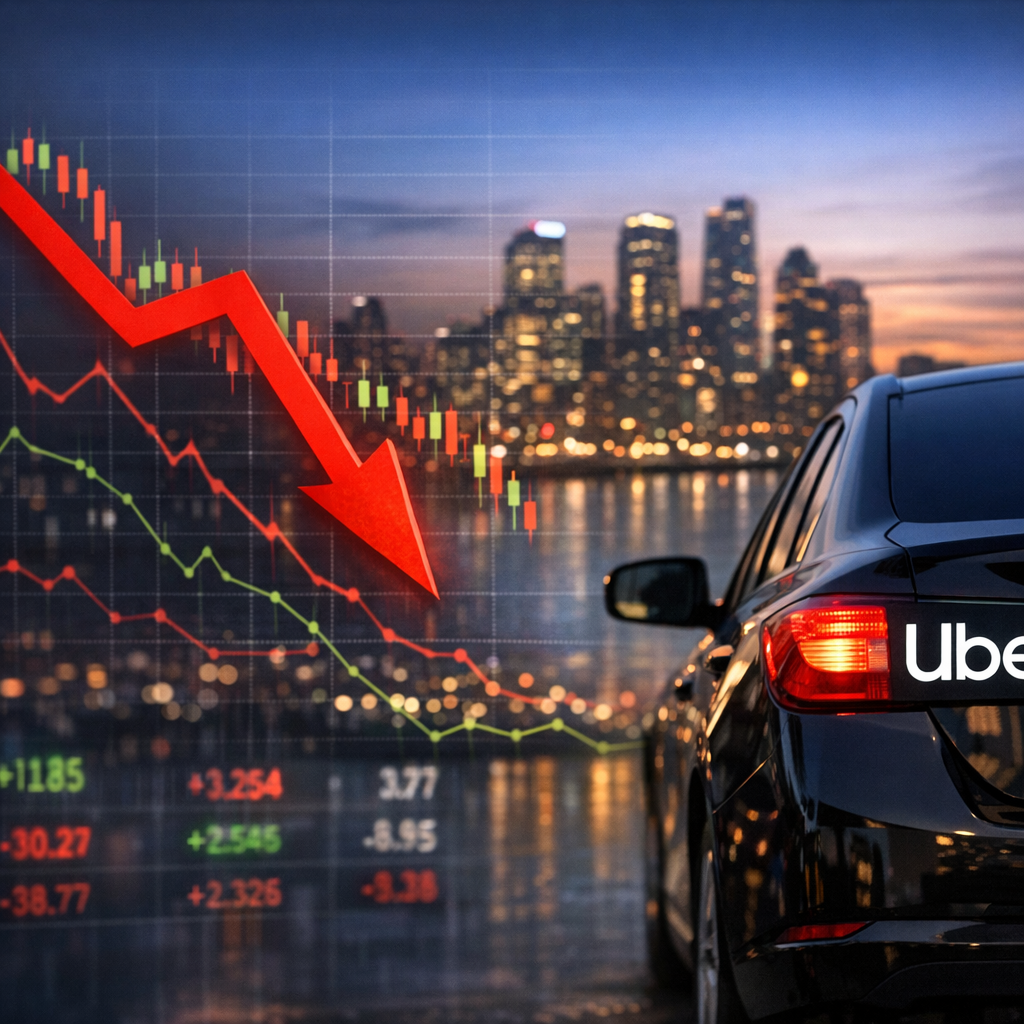
Market Divergence and the Uber Setup
Markets don’t usually give clear warnings—but sometimes, they whisper. Right now, a quiet disconnect is forming between Uber and the broader consumer ecosystem it depends on. While restaurant and retail peers are already reflecting signs of a slowing consumer, Uber’s stock is hovering near all-time highs. That contrast raises a simple but important question: is Uber resilient, or just late to reprice?
In this article, we’ll unpack the idea of “valuation asymmetry” using Uber as a case study. You’ll learn how to compare companies across sectors, why consumer behavior matters more than ever, and what signals investors should watch ahead of earnings. We’ll also look at counterarguments from real investors to keep the analysis balanced.
The Setup: A Market Moving at Different Speeds
Let’s start with the numbers. Several consumer-facing companies have already taken meaningful hits from their highs:
Chipotle is down over 50%. Cheesecake Factory has dropped nearly 28%. Even relatively stable giants like McDonald’s and Walmart are off 7–9%. Meanwhile, Uber is only about 5% below its all-time high.
On the surface, this might not seem unusual—different industries move differently. But the connection becomes clearer when you consider Uber’s business model. Nearly a third of its revenue comes from Uber Eats, its food delivery segment. That makes Uber partially dependent on the same consumer spending trends impacting restaurants.
If restaurant traffic weakens, delivery demand may not be far behind.
(Visual aid suggestion: A simple bar chart comparing percentage declines from ATH across Uber and its peers would help illustrate this divergence.)
Consumer Signals and Competing Interpretations
Consumer Weakness: Signal or Noise?
Chipotle’s recent earnings report highlighted declining traffic, especially among 25–35-year-olds—a demographic that overlaps heavily with Uber’s core user base. The implication is straightforward: if younger consumers are cutting back on dining out, they may also reduce spending on ride-sharing and food delivery.
But not everyone agrees with that conclusion.
Some investors argue that Chipotle’s struggles are company-specific rather than macro-driven. Complaints about rising prices, smaller portions, and declining quality have become more common. One observer noted that a $14 burrito with less value than before might push customers away regardless of broader economic conditions.
This raises an important analytical point: not all weakness is systemic. Sometimes, it’s self-inflicted.
However, others counter that inflation and consumer fatigue are widespread across the restaurant industry. When multiple chains show similar trends, it becomes harder to dismiss the signal as isolated. If consumers are broadly tightening budgets, discretionary services like Uber rides and delivery could feel the impact next.
Expectations, Valuation Asymmetry, and Technical Warnings
Expectations vs. Reality: Why Earnings Matter More Now
Uber’s upcoming earnings carry extra weight because expectations are high. Analysts are projecting earnings per share of $0.67 alongside “high teens” growth in gross bookings. That’s a strong outlook—arguably too strong if consumer demand is softening.
This is where valuation asymmetry comes into play.
When a stock is near its highs, it often requires exceptional results just to move higher. A company must not only meet expectations but exceed them convincingly. On the other hand, any disappointment—even a modest one—can trigger a sharp pullback.
For Uber, the potential outcomes are uneven:
If the company beats expectations, the upside may be limited to a few percentage points. But if it misses or issues cautious guidance, the downside could be significantly larger—perhaps a 10–15% correction to align more closely with peers.
This imbalance is what makes the situation notable. It’s not just about whether Uber performs well—it’s about whether the current price already assumes perfection.
(Visual aid suggestion: A simple risk/reward diagram showing limited upside vs. larger downside would clarify this concept.)
Technical Signals: The Volume Divergence Warning
Beyond fundamentals, there are also technical signals worth paying attention to. One emerging pattern is rising prices accompanied by declining trading volume.
This is often referred to as a bearish divergence. It suggests that fewer investors are supporting the price increase, which can indicate weakening momentum.
A similar pattern appeared in Chipotle’s stock before its sharp decline. While technical indicators are never guarantees, they can act as early warning signs when combined with fundamental concerns.
For Uber, this divergence doesn’t confirm a downturn—but it does add another layer of caution.
Macro Pressures and the Bull Case
Macro Headwinds and Behavioral Shifts
At the heart of this discussion is a broader question: how are consumers adapting to economic pressure?
Gen Z and millennials—key users of Uber—are particularly sensitive to changes in disposable income. Rising rents, student loan payments, and persistent inflation can lead to subtle but meaningful shifts in behavior.
These shifts often start with small trade-offs:
Fewer restaurant visits. Fewer delivery orders. Choosing public transit over ride-sharing. Cooking at home instead of ordering in.
Individually, these decisions seem minor. Collectively, they can reshape demand across entire industries.
Uber’s diversification across mobility and delivery does provide some buffer. However, both segments are still tied to discretionary spending. If consumers pull back broadly, there’s limited insulation.
Counterarguments: Why Uber Might Be Fine
It’s important to acknowledge that not all investors see risk here.
Some argue that Uber is fairly or even undervalued based on metrics like its price-to-earnings ratio, especially compared to traditional tech companies. Others point out that Uber is increasingly viewed as a consumer discretionary business rather than a high-growth tech stock, which may justify its current valuation.
There’s also the innovation angle. Developments like autonomous vehicles and robo-taxi expansion could become major long-term catalysts. For some investors, these future opportunities outweigh short-term concerns about consumer spending.
Finally, not everyone believes a downside scenario would be severe. A modest 3–5% dip, in this view, would be normal volatility rather than a structural repricing.
These perspectives highlight a key reality: markets are rarely one-sided. For every bearish signal, there’s often a bullish interpretation.
Evaluation Framework and Practical Takeaways
How to Evaluate Situations Like This
If you’re trying to make sense of similar setups in the future, here’s a simple process you can follow:
Start by identifying comparable companies or sectors. Look for patterns—are peers moving in the same direction, or is one company diverging?
Next, examine the business model. Ask how directly the company depends on the trends affecting its peers.
Then, assess expectations. High expectations increase downside risk if results disappoint.
Finally, layer in technical and macro signals. No single indicator is decisive, but together they can paint a clearer picture.
(Formatting suggestion: This section could be presented as a numbered checklist for clarity.)
Practical Tips for Investors
When dealing with earnings-driven uncertainty and valuation gaps, a few practical guidelines can help:
Be cautious around asymmetrical setups. If upside is limited and downside is larger, the risk/reward balance may not be favorable.
Don’t rely on a single data point. One company’s weakness doesn’t define an entire sector—but multiple signals might.
Watch guidance more than headlines. Management’s outlook often matters more than the reported numbers.
Separate narrative from numbers. Stories about innovation or future growth are compelling, but current valuation still matters.
Consider position sizing. If uncertainty is high, smaller positions can reduce risk without missing potential upside.
(Visual aid suggestion: A simple checklist graphic summarizing these tips could improve readability.)
Conclusion: A Question of Timing, Not Just Direction
Uber’s current position highlights a classic market tension. On one hand, it’s a strong, diversified platform with improving profitability and long-term growth potential. On the other, it operates within a consumer ecosystem that may be weakening—and its stock price doesn’t yet reflect that risk.
This doesn’t necessarily mean Uber is overvalued or destined to fall. It means expectations are high, and the margin for error is thin.
As earnings approach, the key question isn’t just whether Uber performs well—but whether it performs well enough to justify its premium relative to peers.
For investors, this is a reminder that timing and expectations often matter as much as fundamentals. Markets don’t just react to what happens—they react to the gap between what happens and what was expected.
References and Further Reading
For deeper insights, consider exploring Uber’s latest earnings reports and investor presentations, as well as earnings calls from companies like Chipotle, McDonald’s, and Walmart.
Financial news platforms such as Bloomberg, CNBC, and The Wall Street Journal regularly cover consumer spending trends and sector performance.
For valuation frameworks and earnings analysis techniques, books like “The Little Book of Valuation” by Aswath Damodaran can provide useful context.
Finally, browsing investor discussions (such as those on Reddit or financial forums) can offer diverse perspectives—but always balance them with data-driven analysis.